
Russell Arnott holds a PhD in ocean science from the University of Bath and a first-class Masters in Oceanography from the National Oceanography Centre, Southampton. Currently, he is an Associate Lecturer in Ocean Science at the University of Exeter and lectures in marine science communication on Falmouth University's Marine and Natural History Photography degree. For the EU-funded EPOC project, he coordinates science communication and stakeholder engagement around the Atlantic Meridional Overturning Circulation (AMOC) and its implications for European climate.
His scientific specialism sits at the boundary between ocean physics and plankton biology. Specifically, he studies how and why water moves, and how that movement shapes the microscopic organisms that produce half the oxygen we breathe. Because that boundary crosses oceanography and marine biology, his research is genuinely multidisciplinary.

Over the past decade, Russell has delivered sold-out shows at events across the UK. As a result, he has built a reputation for making difficult science feel urgent and alive to people who didn't expect to care about it. On stage, he has spoken alongside Bear Grylls, Richard Dawkins, Jim Al-Khalili, Jess French, and Megan McCubbin. During a five-week tour of the USA, he presented at the Monterey Bay Aquarium Research Institute and Scripps Institution of Oceanography.
Most recently, he delivered two sold-out shows at Cheltenham Town Hall. He also performed on top of the world's largest ocean-centric map at the National Maritime Museum. As a regular contributor to the New Scientist YouTube channel, his video on orca behaviour has now passed one million views.
Building on a decade as a school science teacher, Russell understands how different audiences learn. To help teachers bring the ocean into their classrooms, he developed a series of training videos for the National College online learning portal. He has also served on the board of directors of the European Marine Science Educators' Association and delivered ocean literacy sessions across the UK and Europe.
In 2025, he served as the UK representative at the University of São Paulo's Advanced School in Ocean Literacy, ahead of the COP30 climate conference. Later that year, he presented at the United Nations Ocean Conference in Nice, France. As a result of that work, Incredible Oceans became a UNESCO-recognised ocean education initiative and part of the Blue Thread network.

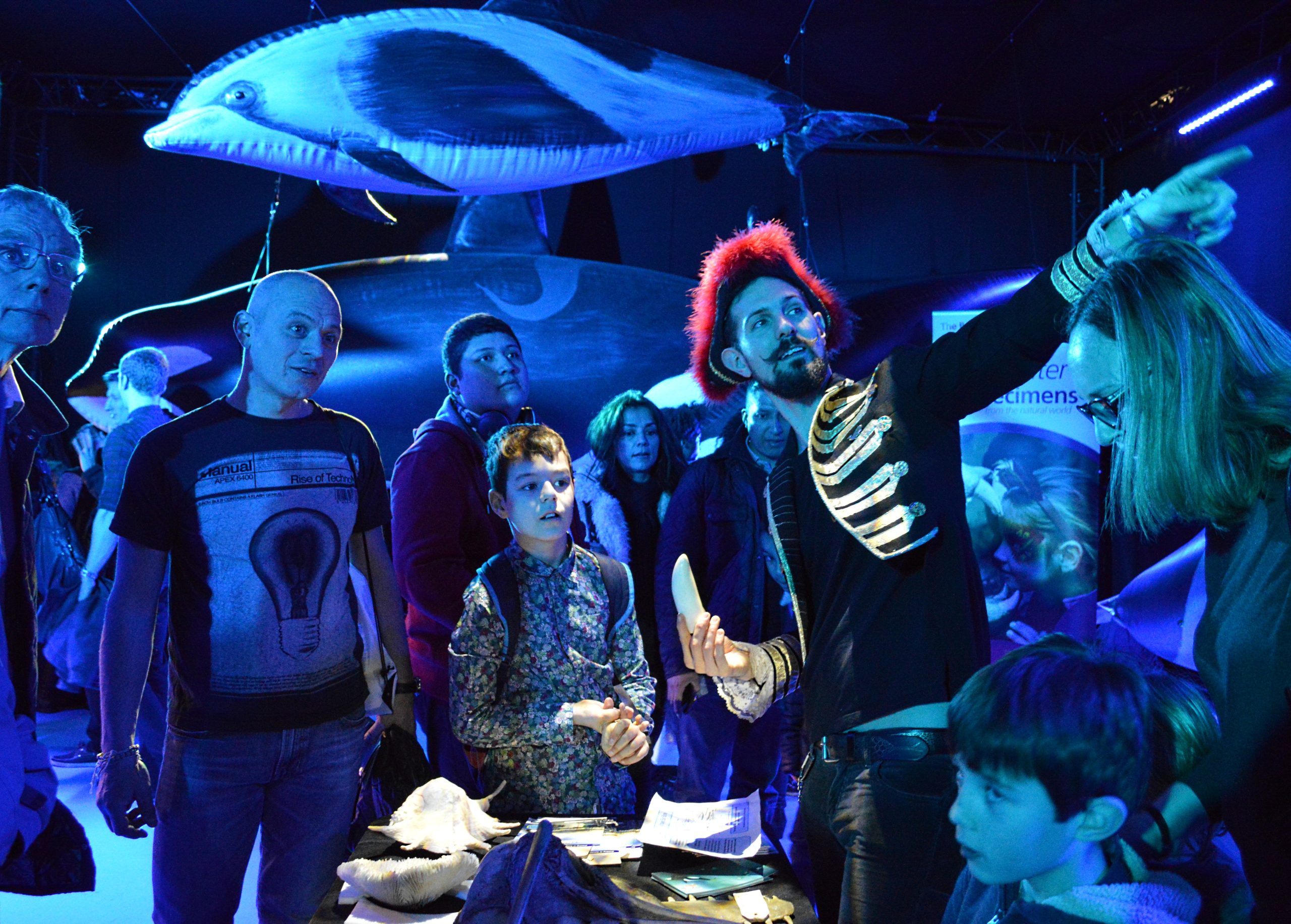
Before any of that, Russell spent a decade teaching science to teenagers in south London. Before that, he toured Europe four times in a punk band, on public transport, with a guitar. Naturally, both experiences show up on stage.
He has ADHD, which he considers an advantage. Because of it, he thinks fast, makes unexpected connections, and is constitutionally incapable of being boring. Together, his science and his energy make for shows that audiences don't forget. He co-authored Ocean Endangered (Flame Tree Publishing, 2021), which has sold over 20,000 copies worldwide. Currently, he is writing books on Antarctic science, octopuses, the deep sea, and plankton. For television and broadcast work, he is represented by David Foster Management.
Russell presents for science festivals, corporate audiences, academic conferences, educator CPD, and broadcast formats. All talks are developed to audience and context.
🌊 The physics of the ocean. Currents, turbulence, mixing, stratification. Why the physical behaviour of the ocean controls almost everything.
🔬 Microscopic ocean life. Plankton; the organisms that quietly run the planet. This is Russell's primary research specialism.
🌡️ Ocean and climate. The ocean's role in absorbing carbon, driving circulation, and mediating the pace of climate change. Evidence-based and directly informed.
🐧 Polar oceans. The Arctic and Antarctic as climate indicators. Ice, biodiversity, and what the poles tell us about the state of our planet. Informed by field experience with the British Antarctic Survey.
🪸 Marine biodiversity and conservation. Keystone species, ecosystem dynamics, and what effective ocean protection actually looks like.
💧 Water and society. Freshwater cycles, water quality, and the human relationship with water as resource.
🎤 Science communication and public engagement. For academic and professional audiences: how to communicate complex science to diverse audiences and stakeholder. Built from over a decade of practice across schools, festivals, broadcast, and corporate contexts.